Remote & Unattended Monitoring
Battery-powered, cellular-enabled water quality monitoring for sites with no power, no network, and no regular maintenance visits. Deploy with the BTSB Smart Box at reservoirs, remote tanks, rest stops, campgrounds, and rural distribution points.
6–12
Months Unattended
5
Parameters Measured
NSF-61
Certified Component
$555
/Year Operating Cost
The Workforce Challenge
Drinking water utilities face increasing workforce challenges. Much of the current workforce is expected to retire in the coming decade, taking institutional knowledge with them. Between 2016 and 2026, an estimated 10.6% of water sector workers will retire or transfer out of the industry.
Unattended sites like campgrounds, rest stops, and mobile home parks often require sending a technician to make manual grab samples of treated drinking water. There is a pressing need to reduce manpower requirements while maintaining water safety.
There is now a practical means to remotely monitor these sites — eliminating manual grab samples entirely.
Halogen Sensors Are Ideal for Remote Monitoring
- check_circleInstalls anywhere — wet-tap, immersion, pipe tee, or flow cell
- check_circleNSF-61 certified for direct drinking water contact
- check_circleMaintenance free for 6 to 12 months
- check_circleCloud monitoring with SMS and email notifications
- check_circleFive parameters from a single sensor probe
- check_circleBattery-powered — no grid electricity required
Proven Results
2,080 Man-Hours Saved
One customer saved 2,080 man hours by deploying just 5 MP5 sensors at remote sites. For most utilities, that translates to $104,000 in annual labor savings — eliminating manual grab sampling trips entirely. Now they have data 24/7 from their problem sites.
50+ Sensors at Highway Rest Stops
Another customer deployed over 50 sensors at rest stops along highways — replacing manual sampling programs with continuous, unattended monitoring. Each site operates autonomously on battery power with cellular cloud reporting.
Key Capabilities
Battery + BTSB Smart Box
Pair a Low Power sensor with the Bluetooth Smart Box (BTSB) and battery for fully autonomous operation — up to 12 months on a single charge. The sensor sleeps between 4-minute measurement cycles to conserve power. Do NOT use the D20 controller at battery sites — it draws too much power.
BTSB-IoT Cellular Telemetry
The BTSB-IoT (available in NA and EMEA variants) includes a built-in cellular modem with eSIM. Transmits encrypted data to Halogen cloud, your cloud, or both via LTE/4G — no local network infrastructure required.
IoT Cloud Dashboard
Centralized control center to access data from anywhere. Configure instant SMS/Email alerts for low residual levels. Adjust sampling intervals (every 15 min, hourly, or daily) via the mobile app to optimize battery life.
How to Deploy
Four steps from unboxing to real-time remote data.
Install the Sensor
Wet-tap allows live installation under pressure up to 145 PSI. Immersion sensors deploy on a chain or float in tanks with cables up to 200 ft (NSF-61 approved). A pipe tee with 2″ slip fitting is the most economical option if the pipe can be shut down.
Connect the BTSB
The BTSB bridges the sensor to the outside world. Choose BTSB-IoT for cellular cloud reporting, BTSB-420 for Sensus FlexNet AMI integration, or base BTSB with Modbus RTU for third-party gateways.
Choose Connectivity
BTSB-IoT for cellular cloud reporting, BTSB-420 for Sensus FlexNet AMI integration, or base BTSB with Modbus RTU for third-party SCADA/IoT gateways. All work on battery power.
Monitor Remotely
Set critical thresholds for low residual and receive immediate push notifications. Configure measurement frequency from the mobile app — every 15 minutes, once per hour, or once per day.
BTSB Smart Box — Choose Your Connectivity
Every remote installation needs a BTSB Smart Box. Choose the variant that matches your communication requirements.
BTSB-IoT
Cellular Cloud Reporting
Built-in LTE/4G cellular modem with eSIM. Transmits to Halogen cloud, customer cloud, or both. Available in NA and EMEA variants. Works on battery — sensor sleeps in 4-minute cycles.
BTSB-420
Sensus FlexNet AMI
4–20 mA adapter with four outputs. Designed for utilities using Xylem Sensus gateway infrastructure. Integrates directly into existing AMI networks for automated meter reading.
BTSB
Bluetooth + Modbus RTU
Basic Bluetooth Smart Box. Connects to the Halogen mobile app for on-site configuration and data retrieval. Modbus RTU output for third-party SCADA or IoT gateways.
Sensors & Installation Options
Choose the sensor and mounting method that fits your site.
Sensor Models
MP-MONO
PN: MP-MONOMonochloramine, free chlorine, pH, conductivity, and temperature. Ideal for chloraminated distribution systems.
MP5 Free Chlorine
PN: MP5Five-parameter flagship — free chlorine, pH, ORP, conductivity, and temperature.
Installation Methods
Wet Tap
D-H1WT-PLive installation under pressure up to 145 PSI. Use with RMR-WT remover kit and corp stop valve.
Immersion or Side Stream
D-H1LF-PImmersion in tanks/reservoirs with cables up to 200 ft, or use with FC-02 Flow Cell Kit for side stream.
PVC Tee
D-H1MF-PMost economical option when the pipe can be shut down. Sensor glues into a 2″ PVC tee with PT-01 adapter.
Typical Vault Installation
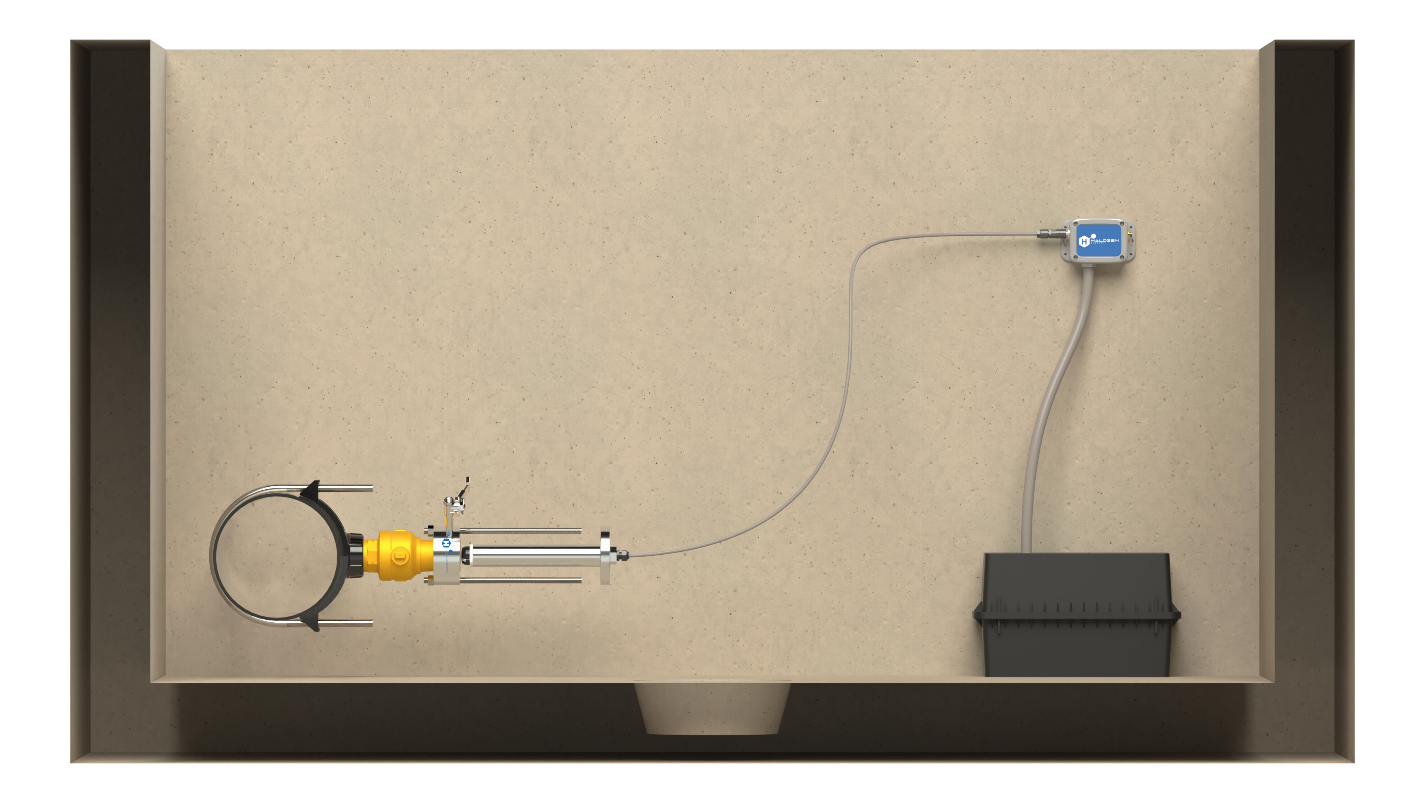
A typical vault installation uses a wet-tap sensor inserted into the water main, connected via M12 cable to a BTSB Smart Box mounted on the vault wall. A LiFePO4 battery provides 6–12 months of autonomous power.
- check_circleSensor wet-taps into live main — no shutdown required
- check_circleBTSB mounts outside metal housing for wireless signal
- check_circleBattery fits inside IP67 waterproof enclosure
- check_circleOptional solar trickle charger extends runtime
Battery Life Calculator
Select your sensor model, battery size, and measurement frequency to estimate battery life and power consumption.
36.7
Months Estimated Battery Life
48
Measurements / Day
0.081
Ah / Day Consumption
| Mode | Duration | Current | Ah / Cycle | Ah / Day |
|---|---|---|---|---|
| Fundamental | 5s | 0.05 A | 0.000069 | 0.0033 |
| Startup | 1s | 0.479 A | 0.000133 | 0.0064 |
| Chlorine + Measurement | 44s | 0.101 A | 0.001234 | 0.0593 |
| Deep Sleep (remainder) | — | 0.0005 A | — | 0.0117 |
| Total Daily Consumption | 50s active | — | — | 0.0806 |
Battery life estimated at 90% depth of discharge (DoD) — standard for LiFePO₄ batteries.
Actual battery life may vary based on temperature, calibration frequency, BLE interaction time, and manual power-on events.
H2 Total features a shorter measurement cycle and lower standby current for extended battery life.
Where to Deploy
Common deployment scenarios for unattended remote monitoring.
Remote Reservoirs & Tanks
Immersion sensors on chains or floats, battery-powered with cellular reporting.
Rural Distribution Dead Ends
Wet-tap into dead-end mains where chlorine residual drops — no power needed.
Water Tower Monitoring
Monitor disinfectant levels at elevated storage tanks with long-range cellular telemetry.
Booster Stations
Track chlorine before and after re-chlorination at remote booster pump stations.
Rest Stops & Campgrounds
Continuous compliance monitoring at unattended recreation and travel facilities — proven at 50+ sites.
Mobile Home Parks
Replace manual grab sampling with continuous automated monitoring at small community water systems.
Frequently Asked Questions
How long can a remote chlorine sensor operate on battery power?
expand_more
What connectivity options exist for remote monitoring without infrastructure?
expand_more
Can remote sensors be installed without shutting down the water main?
expand_more
What water quality parameters are measured?
expand_more
How is remote sensor data accessed and what alerts are available?
expand_more
What does a typical remote monitoring system cost to operate?
expand_more
Eliminate Manual Grab Sampling
Join the utilities saving thousands of man-hours per year with unattended remote chlorine monitoring. Contact us for a site assessment and system recommendation.