 Built for the Field
Engineered for Real-World Conditions
The MP5 sensor is self-cleaning, flow-independent, and built for continuous deployment in any water system.
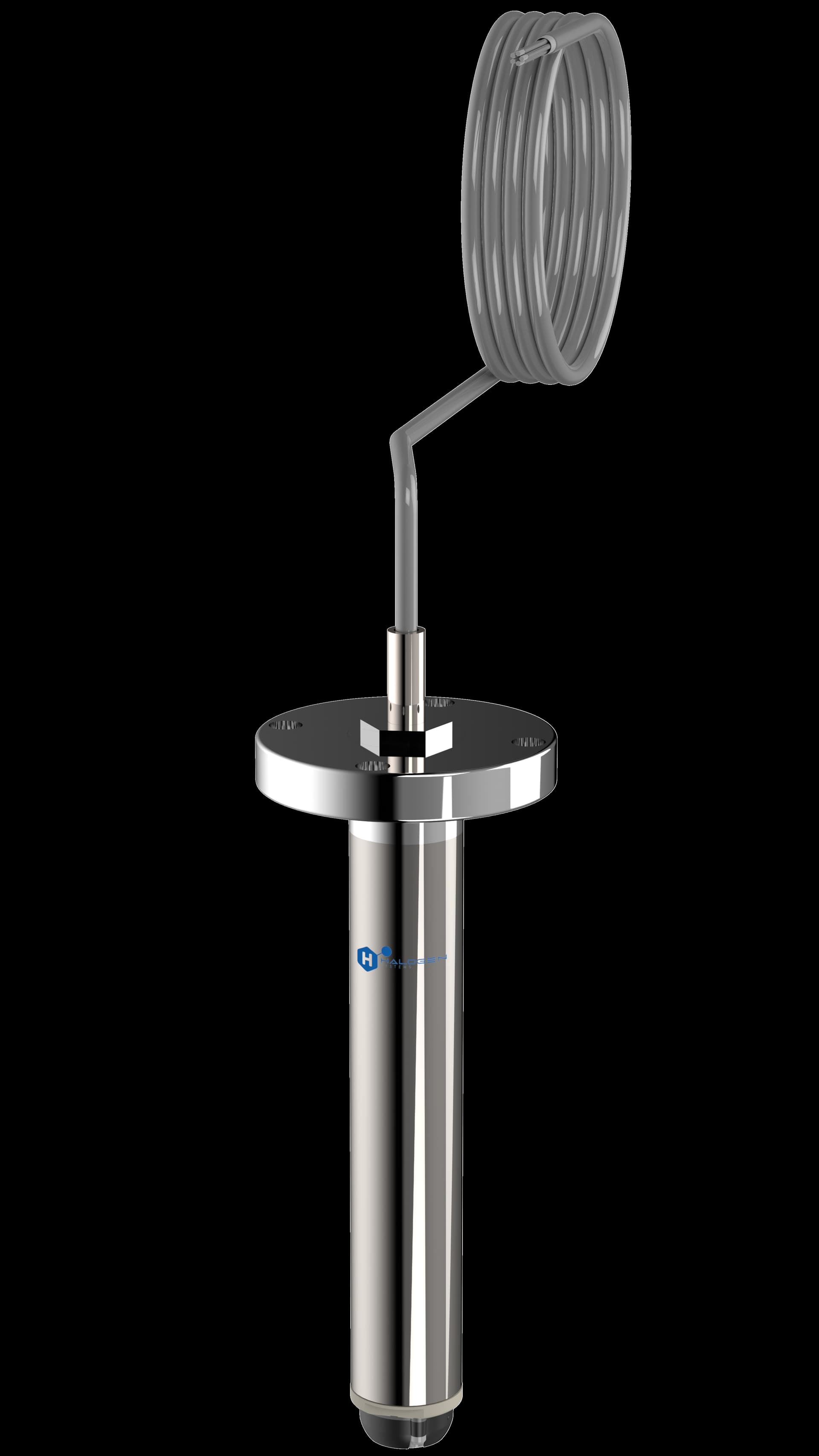
Why Operators Choose Halogen

Self-Cleaning
Integrated SensiCLENE™ mechanical cleaning system ensures accurate readings even in high-fouling environments.
Learn More arrow_forward
NSF-61 Certified
The industry's gold standard for materials and products that come into contact with drinking water.
Learn More arrow_forward
Flow Independent
Maintains accuracy regardless of water flow velocity, ideal for static tank monitoring and dead-end lines.
Learn More arrow_forward
Multiparameter
Single sensor measures Chlorine, pH, ORP, Conductivity, and Temperature simultaneously.
Learn More arrow_forward
Direct In-Pipe
Install directly into main lines without bypass pumps or sample lines, reducing complexity and waste.
Learn More arrow_forward
No Maintenance
Eliminate reagent replenishment and monthly maintenance visits. Annual wear parts swap takes minutes. $555/year total.
Learn More arrow_forward
Install Anywhere
Wet-tap into a main, immerse in a tank, mount in a vault, or drop into a reservoir. No sample panel needed.
Learn More arrow_forward
Works in Zero Flow
Dead ends, storage tanks, clearwells — reads accurately even when water isn't moving. No minimum flow requirement.
Learn More arrow_forward
Remote Monitoring
Battery-powered with cellular or Bluetooth telemetry. IoT cloud delivers real-time data from off-grid sites.
Learn More arrow_forward
Hot Water Monitoring
MP-HOT measures chlorine, pH, conductivity, and temperature in building hot water loops for Legionella compliance.
Learn More arrow_forwardHow Amperometric Chlorine Analysis Works — and Why It Matters
Chlorine disinfection is the primary barrier between safe drinking water and waterborne illness. Utilities are required by the EPA Surface Water Treatment Rule and EPA Total Coliform Rule to maintain a detectable residual throughout their distribution systems at all times. Accurate, continuous measurement is not optional — but the method of measurement has enormous consequences for operational cost, maintenance burden, and reliability.
Amperometric vs. Colorimetric: The Fundamental Difference
The most widely deployed chlorine analyzers use DPD colorimetric chemistry: a liquid reagent reacts with chlorine to produce a pink color, and a photometer reads the color intensity. DPD instruments generate accurate results in a laboratory, but in the field they require daily reagent replenishment, regular membrane cleaning, frequent calibration, and produce a chemical waste stream that must be disposed of properly. Operating costs routinely exceed $2,000 per year per analyzer.
Amperometric sensors work differently: a small electrical potential is applied across two electrodes, and the current that flows is directly proportional to the dissolved chlorine concentration. No dyes, no reagents, no reaction chemistry. The measurement is direct, continuous, and instantaneous. Halogen Systems has taken amperometric analysis further than any other manufacturer by solving the three engineering challenges that previously limited its reliability in field deployments: electrode fouling, flow dependency, and pH cross-interference.
SensiCLENE: Solving the Fouling Problem
Biofouling is the primary failure mode for bare-electrode amperometric sensors in distribution systems. Biofilm accumulates on electrode surfaces within days, blocking the chlorine-electrode reaction and causing readings to drift low — exactly the wrong direction for a safety-critical measurement. Previous solutions involved chemical cleaning agents or periodic manual polishing, both of which introduce labor costs and gaps in monitoring.
Halogen's patented SensiCLENE system uses captive polymer beads suspended in the sensor chamber. A built-in impeller keeps the beads in continuous gentle contact with the electrode surfaces, mechanically scrubbing them clean without any chemicals. The result is stable, drift-free performance for 6 to 12 months between calibrations — a maintenance interval that is 10 to 50 times longer than the industry norm.
Flow Independence and Dead-End Monitoring
Most amperometric sensors are highly sensitive to flow velocity. As water slows, the diffusion layer at the electrode surface thickens and the measured current drops — even if the actual chlorine concentration is unchanged. This limitation makes them unreliable at dead ends, in storage tanks, and at low-flow monitoring points: exactly the locations where chlorine is most likely to be depleted and where continuous monitoring is most valuable.
The HiRes impeller in every Halogen sensor maintains constant local flow across the electrode regardless of what the bulk water is doing. The sensor reads accurately at zero bulk flow, making it suitable for clearwells, distribution dead ends, elevated tanks, and remote reservoirs that could not previously be monitored with amperometric technology.
NSF/ANSI 61 Certification and Regulatory Compliance
NSF/ANSI Standard 61 is the benchmark certification for materials and products that contact drinking water. It requires independent laboratory testing to verify that a product does not leach harmful contaminants at concentrations that exceed health-based thresholds. For a chlorine sensor installed directly in a water main, NSF-61 certification is not a marketing credential — it is a legal prerequisite in most U.S. states for permanent in-pipe installation.
All Halogen MP-series sensors carry NSF/ANSI 61 certification. They are the only reagent-free amperometric chlorine sensors to hold this certification, which is evaluated and renewed annually by an NSF International-accredited testing body.
Legionella Prevention: ASHRAE 188 and Hot Water Monitoring
Legionella pneumophila is the bacterium responsible for Legionnaires' disease, a severe form of pneumonia. The ASHRAE Standard 188 Water Management Plan framework, the CDC Water Management Guidelines, and state-level legislation such as New Jersey S2188 all require building owners to monitor and control conditions in hot water systems that favor Legionella growth: primarily temperature and disinfectant residual.
The MP-HOT sensor was designed specifically for this application. It measures free chlorine, pH, conductivity, and temperature in recirculating hot water loops at up to 140°F, providing the continuous data that water management programs require.
Regulatory References
- NSF/ANSI Standard 61
Drinking water system components — health effects. Required for in-pipe sensor installation.
- ASHRAE Standard 188
Legionellosis: Risk management for building water systems.
- CDC Water Management Program Toolkit
Federal guidance for Legionella prevention in buildings.
- EPA Drinking Water Regulations
National primary drinking water rules including disinfection residuals.
- AWWA Water Quality Resources
American Water Works Association guidance on distribution system monitoring.
Cost Comparison
Per-sensor annual operating cost. Includes calibration, wear parts, reagents, and labor. Calculate your savings →
Published in
Founded 2012
Halogen Systems was spun out of a US Navy / ONR SBIR research program to develop the next generation of compact, reagent-free water quality sensors for shipboard and shore-based water systems.
Our story →Patent Portfolio
Not sure which
sensor fits
your site?
Answer three quick questions about where you’re measuring, how you’re installing, and what power is available — we’ll recommend the exact sensor and mount model.
Where are you measuring chlorine?
Select the environment that best fits your application.
3 questions — takes less than 30 seconds
Trusted by Water Districts Worldwide
“We deployed the MP5 at a remote, low-pressure site where other sensors had struggled. It started up without calibration or flow adjustments and has been running continuously ever since.”
Dean K. Tanimoto
Water Plant Division Chief, County of Maui Dept. of Water Supply
“Two years of operation and only three calibrations. We're actively replacing our entire Hach CL-17 fleet — planning over 50 units county-wide.”
Vinney Guiel
Instrumentation Technician, Palm Beach County Water Utilities
“Our old sensors required three calibrations per shift. The MP5 ran for three months straight with zero calibration — we're estimating 3,800 man-hours saved per year across seven sensors.”
Antonio Thompson
Chief Operator, Iron Bridge Regional WRF, Orlando
“Zero calibration over a six-month pilot with only 0.04 ppm deviation from our reference method. It also eliminates 69,000 gallons per year in waste stream per sensor.”
Derek Nguyen, Ph.D., P.E.
City of Lakewood Water Resources, California
Ready to Eliminate Reagents and Reduce Waste?
Join hundreds of water facilities that have upgraded to Halogen’s maintenance-free chlorine analysis technology.